

A candidate can have an impressive resume, relevant qualifications, and years of experience. But how can employers determine whether they will make the right decisions when faced with real workplace challenges?
Traditional interviews provide valuable insights, but they do not always reveal how candidates approach difficult situations. This is where a situational judgement test can add another layer of understanding to the recruitment process. By presenting realistic workplace scenarios, these assessments help employers evaluate how candidates interpret situations, consider possible actions, and apply their judgement.
In this guide, we explore how situational judgement tests work, practical examples, common scoring methods, and how organisations can use them to make more informed hiring decisions.

What is a Situational Judgement Test?
A situational judgement test (SJT) is a psychometric workplace scenario assessment designed to evaluate how a candidate approaches challenges, solves problems, and interacts with colleagues or clients.
Unlike cognitive ability tests that measure numerical or verbal IQ, or skills tests that assess technical proficiency (such as coding or financial modelling), an SJT measures workplace judgement skills and practical intelligence.
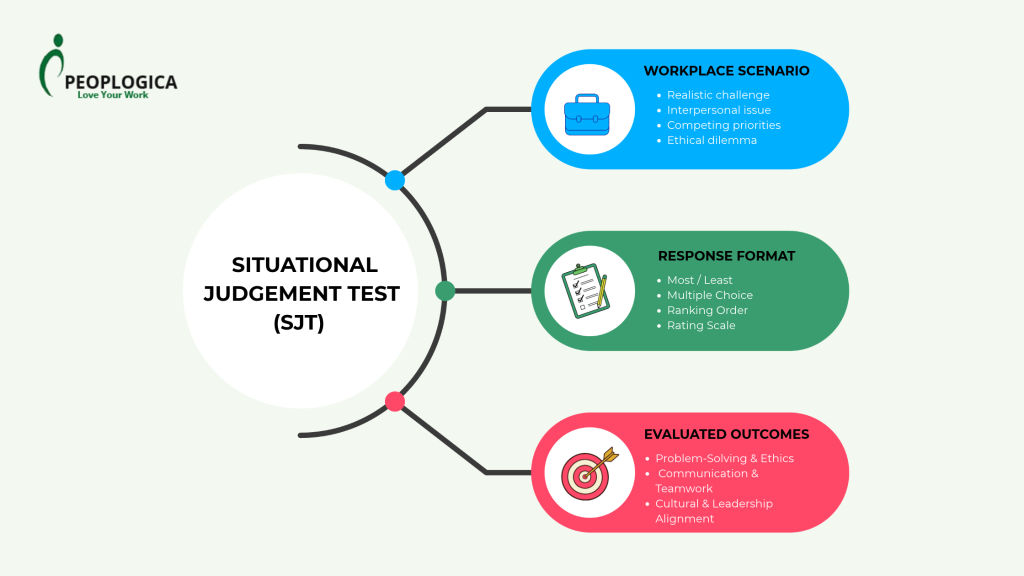
During a situational judgement assessment, candidates are presented with a series of job-related scenario questions detailing a specific work dilemma. Each scenario is followed by a list of potential actions. Depending on the format, candidates are asked to:
– Pick the most effective and least effective response.
– Rank all potential actions from most suitable to least suitable.
– Rate the effectiveness of each proposed solution on a numerical scale.
By presenting realistic job-related situations, SJTs provide hiring managers with structured insights into how candidates evaluate workplace challenges and select appropriate responses. However, these assessments should be used alongside other validated selection methods rather than as a standalone predictor of job performance.
Why Employers Use a Situational Judgement Test for Recruitment?
Using a situational judgement test for recruitment can help organisations improve how they evaluate candidates beyond qualifications and interview impressions. Unstructured interviews may be influenced by unconscious bias, inconsistent questioning, or personal impressions.
When incorporated into a structured candidate selection process, situational judgement tests can help employers assess workplace judgement alongside other job-related criteria, supporting more consistent and informed recruitment decisions.
1. Predicts On-the-Job Performance
Research in organisational psychology suggests that well-designed situational judgement tests can help predict certain aspects of job performance, particularly when assessments reflect realistic workplace challenges.
By evaluating how candidates approach problem-solving, communication, and decision-making, employers can gain additional insights into job-related competencies. However, the predictive value of an SJT depends on its design, scoring method, and relevance to the role.
2. Reduces Bias and Promotes Diversity
Unstructured interviews often lead to hiring decisions based on personal affinity or gut feeling. An automated, standardised workplace decision-making test evaluates every candidate against the exact same benchmark, reducing human bias and improving diversity outcomes.
3. Provides a Realistic Job Preview (RJP)
Situational judgement tests expose candidates to challenges they may encounter in their future roles. This can help applicants understand workplace expectations, responsibilities, and the types of decisions required in the position.
When scenarios accurately reflect the role, they can also help candidates make more informed decisions about their suitability for the opportunity.
4. Efficiently Screens Large Applicant Pools
For organisations managing large applicant pools, standardised assessments can make initial candidate evaluation more consistent and efficient. When appropriately validated and automated, situational assessments can support early-stage screening while allowing recruiters to focus additional attention on candidates who meet relevant job requirements.
Key Competencies Measured by Situational Judgement Assessments
Customised to match key organisational values and job specifications, an SJT evaluates a broad array of core workplace competencies:
| Competency Category | Specific Skills Evaluated | Ideal Candidate Behaviors |
| Communication & Conflict Resolution | Empathy, active listening, de-escalation, direct feedback. | Addresses interpersonal friction directly, maintains professionalism, and listens to understand. |
| Problem Solving & Adaptability | Critical thinking, resourcefulness, managing ambiguity. | Identifies root causes, prioritises long-term solutions over quick fixes, and adapts to changes. |
| Teamwork & Collaboration | Team player mindset, cross-functional cooperation, support. | Supports struggling colleagues, shares credit, and aligns personal work with team goals. |
| Integrity & Professional Ethics | Accountable, policy adherence, handling sensitive information. | Takes responsibility for mistakes, protects confidential data, and upholds corporate compliance. |
| Leadership & Prioritisation | Time management, delegation, stakeholder management. | Balances urgency versus importance, delegates effectively, and manages expectations. |
The specific competencies measured should be established through job analysis rather than assuming that every SJT evaluates all these capabilities.
Situational Judgement Test Examples & Sample Questions
Reviewing situational judgement test sample questions helps illustrate how these assessments measure workplace decisions in context.
Scenario 1: Managing Competing Priorities (Individual Contributor Role)
Scenario: You are working on a high-priority project with a deadline at the end of the day. A team member asks you to immediately help them resolve an urgent customer issue that falls under your area of expertise. If you assist them, you risk missing your own deadline.
Possible Options:
- A: Ignore your colleague’s request and focus exclusively on your own project to ensure it is submitted on time.
- B: Stop working on your project immediately and help your colleague resolve the customer issue, then work late to finish your assignment.
- C: Assess the severity of the customer issue. If it requires immediate attention, notify your team lead of the situation and ask for assistance in reallocating your project work before helping your colleague.
- D: Tell your colleague that you are too busy and suggest they ask someone else on the team for help.
Answer Breakdown:
- Most Effective Action: C – Demonstrates proactive communication, risk assessment, and proper stakeholder management without making unilateral compromises.
- Least Effective Action: A – Ignores customer impact and fails to collaborate with team members.
Scenario 2: Handling Workplace Conflict (Management / Team Lead Role)
Scenario: Two key members of your project team disagree strongly on the technical approach for a new product feature. The dispute is escalating, stalling team meetings, and delaying project milestones.
Possible Options:
- A: Step in immediately and select the approach you prefer to keep the project moving forward.
- B: Schedule a private meeting with both team members. Have each present their case using data, facilitate a constructive discussion to find common ground, and agree on a path forward.
- C: Allow them to resolve the issue on their own so they can develop better working relationships independently.
- D: Reassign one of the team members to a different project to eliminate the conflict.
Answer Breakdown:
- Most Effective Action: B – Addresses the root cause through structured mediation, reliance on data, and consensus-building.
- Least Effective Action: D – Avoids the core issue, disrupts project staffing, and sets a poor precedent for conflict resolution.
How Situational Judgement Tests Are Scored?
Situational judgement test scoring depends on the assessment format, the competencies being measured, and the scoring model established during test development. There is no single scoring method that applies to every SJT.
1. Best-Answer Scoring
Candidates select the most effective response from several alternatives. Answers receive scores according to a predefined scoring key, often developed with input from job experts.
2. Ranking-Based Scoring
Candidates rank different responses from most to least effective. Their rankings are compared against an established reference order, with scores reflecting how closely their responses align.
3. Effectiveness Rating
Candidates evaluate each proposed action using a rating scale, such as highly ineffective to highly effective. This approach can provide more detailed information about how candidates distinguish between different responses.
4. Partial-Credit Scoring
Some assessments award partial credit when an answer is reasonable but not considered the most effective option. This recognises that workplace decisions are not always strictly right or wrong.
Research published in the Journal of Vocational Behavior highlights that the choice of scoring method can influence the validity of situational judgement assessments.
Importantly, a high SJT score should not automatically be treated as proof of superior job performance. Scores must be interpreted in relation to the role, assessment quality, and other recruitment evidence.
How to Implement Situational Judgement Tests in Recruitment
An effective workplace scenario assessment requires more than creating hypothetical questions. Organisations should follow a structured development and implementation process.
Step 1: Identify Critical Job Competencies
Start by defining the knowledge, skills, and behaviours required for success in the role.
For example, a customer service position may require empathy and problem-solving, while a management position may place greater emphasis on leadership and conflict resolution.
Step 2: Develop Realistic Scenarios
Create job-related scenario questions based on situations employees are likely to experience. Use input from experienced employees, managers, and job experts to ensure scenarios reflect workplace realities.
Step 3: Establish Reliable Scoring Criteria
Develop a scoring key based on expert judgement and relevant job requirements. Pilot the assessment and examine its reliability, validity, and fairness before relying on results for selection.
Step 4: Combine Multiple Assessment Methods
SJTs should be part of a broader evaluation process. For example, organisations can combine them with PeoplogicaSkills to assess practical workplace capabilities alongside scenario-based judgement.
Step 5: Monitor and Improve the Assessment
Regularly review assessment performance, candidate feedback, and hiring outcomes.
Update scenarios when job responsibilities, workplace policies, or competency requirements change. This helps maintain the assessment’s relevance over time.
Limitations of Situational Judgement Tests
Although SJTs provide valuable information, employers should understand their limitations. A candidate may recognise the most appropriate answer without consistently demonstrating that behaviour at work.
Similarly, scenarios that lack job relevance may provide limited insight into actual performance.
Other considerations include:
– Candidates may recognise socially desirable responses.
– Poorly written scenarios can create ambiguity.
– Reading demands may affect results independently of the intended competency.
– Scoring systems require appropriate development and validation.
– Tests should be reviewed for accessibility, fairness, and potential adverse impact.
These limitations explain why a situational judgement test should support, rather than replace, other evidence-based hiring methods.
How Peoplogica Supports Better Recruitment Decisions?
Understanding a candidate’s workplace judgement skills is only one part of identifying the right person for a role.Organisations also need to evaluate practical abilities, behavioural characteristics, and alignment with the requirements of the position.
Peoplogica helps organisations make more informed recruitment decisions through structured candidate selection, role benchmarking, psychometric assessments, and skills testing.
Its assessment solutions help hiring teams evaluate candidates using job-relevant information rather than relying solely on resumes or interview impressions.
By combining complementary assessment methods, organisations can build a clearer picture of candidate strengths, potential development needs, and suitability for specific responsibilities.
Explore our best recruitment and selection solutions to build a more structured, evidence-based hiring process.
Conclusion
A situational judgement test helps employers understand how candidates evaluate realistic workplace challenges and identify appropriate courses of action.
Through job-related scenarios, structured responses, and carefully developed scoring methods, these assessments can provide useful insights into decision-making, communication, teamwork, and leadership judgement.
However, their effectiveness depends on assessment design, job relevance, validation, and responsible interpretation. When combined with structured interviews, psychometric assessments, and skills testing, situational judgement tests can contribute to a more consistent and informed recruitment process.
For organisations seeking stronger hiring outcomes, the objective is not simply to identify candidates who know the right answers. It is to build a selection process that gathers meaningful evidence about the capabilities needed for success.
Frequently Asked Questions (FAQs)
Q: What is a situational judgement test?
A: A situational judgement test (SJT) is a standardised psychometric assessment that presents candidates with realistic, job-related scenarios and asks them to evaluate possible responses. It measures practical decision-making, problem-solving, communication, and behavioral alignment with organisational expectations.
Q: How are situational judgement tests scored?
A: Situational judgement tests are scored by comparing a candidate’s responses against an established benchmark key. This scoring standard is created by I/O psychologists, industry experts, or an organisation’s highest-performing employees. Candidates earn points based on how closely their choices align with the most effective actions.
Q: Are situational judgement tests timed?
A: Some situational judgement tests are timed, while others allow candidates to complete scenarios without strict time limits. The duration depends on the assessment provider, question complexity, and competencies being evaluated. Employers should ensure that time limits are relevant to the role and do not create unnecessary barriers for candidates.
Q: Can candidates prepare for situational judgement test sample questions?
A: Yes. Candidates can prepare by taking practice assessments, studying the core values and competency frameworks of their target employer, and analysing workplace scenarios to identify key issues, stakeholder impacts, and ethical constraints before choosing a solution.
